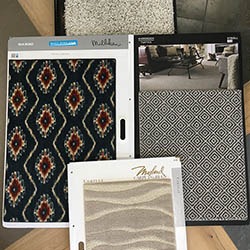
Rugs Flooring

Rugs Floors

Rugs used to be made by hand what we call handmade rugs nowhadays everything is machine made which we call machine made rugs. Depending on the purpose and area we find several different kind of rugs.

Types of Rugs for Flooring

Abrash Rugs Floor: Change or variation in the color of a rug due to differences in the wool or dye bath. The effect of abrash is subtle shading differences. In older or antique rugs, abrash occurs naturally. In new rugs, both machine made and hand made, abrash is carefully created by changing the color of the yarns to mimic a vintage look.

Border Rugs Floor: Design that runs along the sides of the rug to frame the main design in the rug’s field. Some rugs, usually traditional designs, use multiple borders. Other rugs, usually contemporary styles, don’t use borders.

Braided Rugs Floor: Braided rugs represent a unique American handicraft. In Early American times, braided rugs were made using old clothing and household rags that were braided together to form a floor covering. Today, the braided yarns are made by machine and then fashioned using a sewing machine to form traditional ovals or modern squares and rectangles. Braided rugs come in and out of favor, but never disappear entirely.

Contemporary Rugs Floor: Refers to non-traditional rug designs ranging from simple border designs to hard-edge geometrics and asymmetrical patterns. Relaxed contemporary usually refers to rugs that are easy to adapt to any decorating style.

Field Rugs Floor: Central part of a rug design, generally surrounded by a border. The field design is often formal and symmetrical, particularly in traditional Oriental and French designs.

Ground Rugs Floor: Background color which sets off the principle design motif of the rug.

Hand Rugs Floor: Tactile qualities of the rug’s surface, usually described as soft, stiff, rough, scratchy, etc.

Pile Rugs Floor: Cut or looped yarns that form the surface of carpets or rugs.

Texture Rugs Floor: Refers to the surface of the rug. Textures include plush cut pile (soft); loop (nubby) pile, and combination cut-and-loop pile. Depending on the denier (thickness) of the yarn or size of the knots, textures can range from very soft to very rough.

Tone-on-tone Rugs Floor: Two or more shades of the same color.

Traditional Rugs Floor: Styling designation that refers to long-established patterns in the Oriental/Persian or classic European schools. In new rugs, traditional designs are produced either in modern colorations or in colors that replicate antique rugs.

Transitional Rugs Floor: A broad style category that falls between traditional and contemporary. Many floral patterns are included in this category.

Handmade rug terms

Aubusson/tapestry weave: Hand weaving method originating in France in which the "stitches" on the face look more linear, and the back may look "stringy." This occurs when the weaver changes yarn colors. The weave looks similar to needlepoint.

Flat weave: Unlike hand-knotted rugs, flat-weave rugs are hand made on looms and require less skill than hand-knotted constructions. The weft (face design) yarns are simply passed through the warp strands. Dhurries are flat-woven rugs that originate in India and usually are made of cotton or wool. Kilims are generally finer, tapestry-like flat weaves.

Fringe: The warp’s selvage end at the top and bottom of a rug. Machine-made rugs do not have naturally occurring fringe, so in some cases, particularly with traditional designs, fringe is sewn on to the top and bottom of the rug.

Hand made: Constructed by hand. The category can include hand knotted, hand tufted, hand hooked, needlepoint, Aubusson and hand loomed rugs.

Hand hooked/hand tufted: Rug-making process by which craftsmen insert yarn into a backing with a hand-held single-needle tufting tool. The tool often is called a "gun." The hooking instrument can be either powered by electricity or completely manual. The rug's pattern is stenciled on primary backing material. After the tufting is complete, a backing is attached to protect and anchor the stitches. The pile of a hand-hooked rug is made up of loops. A hand-tufted rug has a cut pile surface. Rugs may also combine cut and loop techniques. A rug that has a total cut pile appearance is also described as "full cut."

Hand knotted: Rug made by weavers who knot pile yarns around the warp fibers that run the length of the rug. Generally, the more knots per square inch, the more valuable the rug.

Knot count: The number of knots in a square inch of a rug. Hand-made Chinese rugs are often described in terms of "line." A 65-line rug would have 65 knots per foot of width, 65 knots per foot of length, and 29 knots per square inch.

Needlepoint: A rug-making technique made with wool yarns worked on canvas using the same method as a needlepoint pillow.

Tibetan knot: A distinctive rug-weaving technique now used in other regions as well as in Tibet. A temporary rod, which establishes the length of pile, is put in front of the warp. A continuous yarn is looped around two warps and then once around the rod. When a row of loops is finished, then the loops are cut to create the pile. This method produces a slightly ridged or corduroy textured surface.

Warp:
Vertical strands of fiber, which stretch from the top to the bottom of the rug. Knots are tied to the warp yarns to create face pile.

Weft: Horizontal strands of fiber that are woven through the warps. The weft anchors and secures the knots.

Machine-made rug terms

Fabricated (or inlaid) rugs: Tufted broadloom carpet is cut and inlaid on a patterned form to create a customized rug.

Frames: Racks which hold spools of yarn on a Wilton loom. Each frame holds a separate color creel. Thus an eight-frame Wilton weaves an eight-color rug.

Machine made: A rug constructed on an electrically powered machine, now usually computer controlled.

Power loomed: This has become the preferred term for machine-made rugs.

Machine tufting: A technology developed in the United States in which yarn ends are placed into a backing in a manner similar to a sewing machine equipped with hundreds of needles. Tufting machinery is usually 12 or 15 feet wide. Most wall-to-wall carpeting in the United States is tufted. Machine-tufted rugs are usually inexpensive and sold through mass merchants and discount stores.

Wilton and Axminster: Types of looms used to weave rugs in multi-colored patterns. Patterns are controlled by electronic placement of yarns. Modern looms are computer-controlled machines which can produce rugs in up to 12 colors.

Fiber terms

Acrylic: Man-made fiber with wool-like hand. Hand-tufted acrylic rugs in accent sizes have been introduced in the United States during the past five years. Rugs over 20 square feet must be made of modified acrylic (Modacrylic) in order to pass U.S. flammability standards.

Continuous filament: Nylon or polypropylene yarn made in one long strand that can be tufted or woven without the need for further processing.

BCF: Bulked continuous filament yarns are synthetic yarns that are processed to “bulk” or fluff out, creating a softer texture.

Faux silk: "False” silk is usually a synthetic, such as polyester, or a cellulosic fiber such as viscose/rayon. Mercerized cotton is also used as a silk look-alike. Also called art silk, faux silk is used in both hand-made and machine-made constructions.

Heat set: Twisted yarns are treated with heat to retain their "permanent wave" for better performance and appearance. Heat-set yarns do not flatten out.

Nylon: Durable and versatile synthetic fiber which also has good dyeing characteristics. Nylon yarns can be solution dyed, skein dyed and/or space dyed. In today’s concern for “green” materials, some nylon yarns are recyclable or made using botanical oils rather than petroleum-based raw materials.

Polyester: Synthetic fiber most often used in staple spun yarns. Provides a soft hand with the look of wool.

Polypropylene/Olefin: Synthetic fiber used extensively in machine-made rugs. This low-cost fiber is colored in the pellet phase of production. Performs best when heat set and/or used in a dense construction.

Solution dyed: A method of dyeing synthetic fiber in which pigment is added to the nylon or polypropylene chip before it is extruded as filament yarn.

Space dyed: Yarn colored in sections of different colors before being tufted or woven into a rug. Abrash effects can be created with space-dyed yarns. Space dyeing is frequently applied to nylon fibers.

Wool: The term usually refers to sheep’s wool, although other types of animal wool are used in rugs, such as yak or alpaca. There are many grades of wool. Long-staple wool from New Zealand is considered to be excellent for rug making.

Worsted: An extra step in wool processing that combs out shorter fibers, resulting in durable and lustrous yarns.


News & Tips ..

Note: A Licensed contractor is the way to go.

"Go Green".Carefree Floors uses environmentally preferred, floor cleaning products. We also offer a complete selection of environmentally friendly flooring, bath & countertop products, including: carpet, stone, tile, wood, bamboo, cork...